Friday, November 21, 2014

Various paintings from class

I've been taking a semester long class where we meet all day once a week, and have painted a variety of things since September.  One of the things I love about taking a class like this is that it requires me to set aside time each and every week to paint, regardless of what my schedule is like.  Of course, I often paint more frequently than that, but that's not always the case-- so its a good thing that that special time is always reserved.  Also, it gets me to paint subjects I wouldn't normally approach, and to develop and hone techniques that I sometimes think I've got enough under control... but could still use some practice on.  ;)

Most of these are smaller, 1/8 sheets- 7.5" x 5".  A common size for me to experiment on in class.


Friday, November 14, 2014

Sketches from October in Barcelona

View from our window at night

We were back in Barcelona for a 10 day trip in October, and that meant I had some regular time to do sketching.  City scapes and people.  Fun!  This is an assortment from the trip.

 
 On Princessa St.


 In the square at Narbonne France for the day!


Friday, November 7, 2014

6 Summer Reading Books for Watercolor Nerds!

This last Spring and Summer, I dug into a number of different books that had been recommended to me.  I'm not really sure they qualify as light "summer reading" (!), but even so I wanted to pass along those recommendations with a brief synopsis of my own thoughts on each book.  I've thrown in Gurney's "Color and Light" (which I read a few years ago) because I haven't talked about it much here, but I consider it essential reading.  If you have recommendations of your own, please offer them up.  Always looking for good reading.  :)

1) "Hawthorne On Painting" by Charles Hawthorn
     4.5 stars, if you like watercolor philosophy, but aren't looking for specifics on technique
2) Joseph Zbukvic's "Mastering Atmosphere and Mood in Watercolor"
     5 stars, if you like his technique or style
3) James Gurney's "Color and Light: A Guide for the Realist Painter"
     5 stars, if you like knowing how light and color work scientifically, and only then being show
           how to apply them
4) "Landscape Painting: Essential Concepts and Techniques for Plein Air and Studio Practice" by Mitchell Albala
     3 stars, perhaps more if you've not read Gurney's book, or paint with acrylics or oils
5) "Carlson's Guide to Landscape Painting" by John Carlson
     2 stars, though there are bits I found more interesting than that
6) Ron Ranson's On Skies: Techniques on Watercolor and Other Media
     3 stars, if you love clouds and skies, less if they're not that important to your subject matter


Hawthorne on Painting is the easiest and most "inspiring" read of the bunch.  It's short (less than 100 pages), cheap, and full of really loose, conversational excerpts and quotes from lectures he gave while teaching plein air watercolor and acrylics in the early 1900's.  It's worth noting that although I like some of Hawthorne's work, he's by far not a favorite of mine.  He also is primarily an acrylic painter.  Even so, I liked the book's breezy tone, and how it focused more on seeing the world, how to view things and compose a striking image, how to think as an artist sharing an emotion and mood, and less on specific techniques.  I carried a pencil with me while I read it and marked and highlighted many things.  He has the cadence and clear vocabulary of a seasoned teacher who knows what he thinks, and has learned to share it succinctly.  That clarity helps to carry his opinions across the medium to watercolors (which he also talks about specifically, as well-- just less).  Of the 4 new books, its by far the one I'll be most likely to reread and browse through.  It's the sort of book you'll find a quote from that you'll carry with you for a long while (as well as a few you'll completely disagree with!).  I guess earlier copies of the book had full color pictures that went with the excerpts-- that sounds wonderful, honestly, and with they were here, but 7$, it's hard to fault the book for what it so readily and eloquently provides.
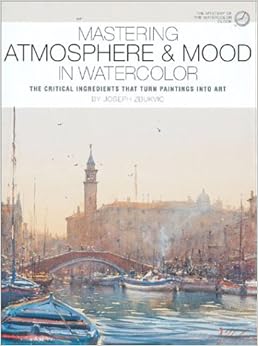

Zbukvic's Mastering Atmosphere and Mood in Watercolor is a book I long wanted to read, but I never had the 300$ to purchase a used copy of the out-of-print book off of Amazon. Then I asked for an interlibrary loan, and voila! I got the opportunity.  Then I read and re-read it.  :)  It's worth being upfront and making it clear that Zbukvic is easily one of my favorite living painters.  So it was a book I was interested in reading because I love the work he produces.  Compared to Hawthorne on Painting, this one is all about technique and composition, but was well worth it, IMO.  Zbukvic spends a lot of time setting up and explaining his "Watercolor Clock", a really marvelous visual teaching too, and then, using it, discusses the affects and interactions of various ratios of water and pigment.  How wet is the paper?  How much pigment do you have on the brush?  How wet is your brush?  All this is very central to the best parts of the book.  He also talks about the value of having a "Mother Color" and how this guides his color choices.  I've actually written up a far more detailed post on the book, which I took from the notes I wrote and typed up while reading it.  So, hopefully, I'll be sharing that at a later point, but at the very least, this is a book well worth reading on your own, if you can get your hands on it.
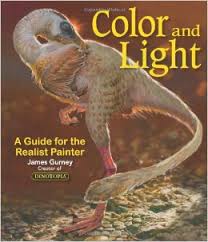


Gurney's "Color and Light" is a book I actually read a year or two ago, but it's such a great, functional, useful read, and so essential, IMO, to understanding... well... light and color, that I had to put it in this list.  If I was going to buy one book on painting realistically, this is the one I'd get.  It's cheap, its full of full color pics, the chapters are short, topical, and to the point with useful info.  It's got a hands on approach to what it offers-- it's not about theory, it's about how the world looks when you view it, why things work they way they do scientifically, and how you can reproduce those kinds of results if you want to.  It changed the way I viewed many things, which is a great gift in and of itself, but it also helped me acquire a kind of short hand for how to view and compose things for my paintings.  Some stuff that it points out about how light and color work seems so obvious and straightforward now that I've read the book, but beforehand, I never would have noticed so many beautiful and interesting details that, when selectively brought into a painting, give a work a compelling veracity.  Well, well worth the read. 
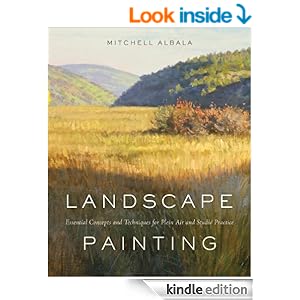


Mitchell's Landscape Painting- Essential Concepts and Techniques was a book that had come highly recommended, but I found a bit underwhelming, personally.  Perhaps I was looking for something other than it offered, or perhaps it was how it was basically focused on acrylics and oils.  Perhaps it was because I had already read things like Gurney's" Color and Light", and they shared similar info.  Who knows?  Either way, I got it for free from the library and browsed and read it over for a number of weeks.  It was fine reading, and perhaps very good reading for acrylic and oil painters, but I think watercolorists would be better served by reading Zbukvic's book in combination with Gurney's.  For free though, it was a fine way to spend some time, and many of the images are beautiful.


Carlson's Guide to Landscape Painting is supposedly what Mitchell's Landscape Painting book is based on/ was used for inspiration/ was influenced by/ was updating.  Needless to say, the two share a lot of similar info.  Mitchell's is just more modern and has full color pictures.  Carlson's is all black and white reproductions of art.  It's supposedly to help you pay attention to value more, and it does that, but it also feels cheap.  There's some good stuff in there, if you can wade through the verbage, just as there is in Mitchell's book.  Some useful, direct info about understanding color and distance, skies, clouds, etc. That sort of stuff.  The problem is that the book was written around 100 years ago, so the language can be dense and slow.  Throw in the fact that all the images are black and white (even when he's talking about color, and not value), and you've got what can be a (useful) challenge.  The book is available in paperback, and so it's cheap on Amazon.  For the 10$, it was worth it to me.  For free, from a library, I'd browse a copy at the very least, along with Mitchell's more expensive hardcover, to help you decide if you'd like to take it home with you.


And, for a sense of completion, Ron Ranson's On Skies.  I'm not a big fan of Ron Ranson's work, per se, but I ran into this book for free a year or two ago and so I read it.  If you can get a free copy and are curious about clouds and skies (and certain loose watercolor techniques for how you might paint them), I think it's worth your time.  It's full of lots of illustrations, which is helpful, and at the time I read it, any help painting was good help. It's not the best book on painting I've read-- in fact, it's super focused in it's subject matter-- but I love clouds, and it was interesting and helpful to read and learn about them, how they form and behave, and some of his wet into wet techniques for painting them.

Saturday, November 1, 2014

Getting those first 100 paintings under your belt...

I was browsing my portfolio the other day, when I got sucked in to the vortex of artsy laziness and decided to count up the paintings I've saved and sort of "quantify" my growth over the last 4 years.  What amazed me isn't that I've improved (I would be sad if I felt I hadn't improved atleast some!), but how a marked increase in recent production has so obviously gone hand in hand with the development of my skills and vision.  I remember reading some advice from more experienced painters that you need to paint! paint! paint! and that a novice painter just needs to get those 100 first paintings under his belt.  Well, now that I'm here, on the other side of that 100, I can't agree more. 

Over the first 3 years, I painted about 50 paintings, total.  I took two semester-long watercolor classes back in 2011, and they helped me produce work and learn basic skills.  I then did some abstract work on my own, bit by bit.  Along the way, I joined the artist community at WetCanvas, I researched and learned about color theory, I did my two murals, I did some digital linework, and, ever so slowly, I kept painting watercolors.  Still, all in all, that's only about 1.5 watercolor paintings a month.  I could copy an image with glazes pretty well if I wanted to, but here's what I got when I tried to compose an image of my own last October-


Comparatively, I count that I've painted atleast 100 paintings in the last 9 months, which averages out to just about 3 paintings a week.  Holy mole!  That surprised me.  My (crappy) math skills tell me that's a 750% increase. LOL.  Here's a recent painting I did, after all that playtime-


Good teachers matter, and I've searched some out.  Well written books or instructional videos matter, and I've read some. Good tools matter, and I bought them.  I think they all very clearly have made learning easier.  But nothing, in my opinion, takes the place of...well... the almost mechanical fact that you just. need. to. paint.... a lot. if you want to learn how to paint.

You can learn a lot from failing.  In fact, you really HAVE to fail if you want to learn. So, I guess the goal is that I have many more failures, right?  :D

Friday, October 17, 2014

My Bjorn Bernstrom Watercolor Workshop, pt. 3


Painting with Water


In this final post, I wanted to share Bjorn's process for painting wetter.  I know, is that even possible?  Yep.  Bjorn sometimes paints his clouds, as well as his distant tree lines by deliberately creating back runs.  He also sometimes paints reflections and skies, even the shadowed masses of mountains, by painting very wet into wet—using that “brush pinching” technique I outlined in the previous post.  I’ll be going over both of these.


So, in these pics from the first demo, he’s leaning in and deliberately dabbing in lots of watery pigment to the horizon line.  He’s already painted the sky, which has dried a bit but is still damp.  He’s also already cut the shape of the buildings.  In this example, he’s also painted a simple wash over the foreground as well, which is separated from the sky.  He gets that water and pigment in there, bridging the two, and lets it push.  Looking at the pics in succession, you can see the time lapse element of the process, as the paint Bjorn is pushing in begins to expand into the sky and form the tree line.  I've made the photos extra large, to help you see in there better.


When you’re done, you can create fascinating treelines, with a distinctive crinkled look that you can’t get with a brush.  No two really come out the same.  Add in additional color to the tree area, as the water begins to bloom; do more water here and less there to create perspective; paint your background lighter or darker to create a different kind of rim, etc. 

Sometimes he paints over the bottom portion of the painting with a darker color, blending the treeline into the horizontal foreground, as in these.


Sometimes he lets the boom play at the horizon line and works with it, as in this pic, on the right.


Additionally, he uses this technique sometimes for clouds banks on the horizon.  This was done by adding nothing but a single swipe of water from a loaded brush across a mostly dry sky.  It really painted itself, once he had waited long enough for the reactions to work out properly.


Sometimes, he used it for clouds too.  This technique was very delicate, and required a great deal of patience.  The paper has to be almost dry, and Bjorn spent a lot of time just gently touching the paper with the side of palm, to assess just how wet/cool it was.   Too wet, and the water you lay in just explodes everywhere.  Wait too long, and it does almost nothing.  


His quote that “The hardest thing for a watercolor artists to do is to be patient.  You must learn to have patience, even when it’s boring” was dead on.  I tried this some during the workshop.  My results were less than satisfactory.  Hahaha!  Eventually, I stopped trying to paint “pictures”, and just worked on technique.


 The other thing I wanted to show a bit of was how he would pour, super wet into wet, also using the “pinching” technique, with more diluted solutions in his brush.  He deliberately did this when painting these mountains, which were from another demo he did for us.


He put in the first light washes, to mold the mountains' surfaces.  Then he dried it with a hair drier.  He came back in and cut the shape out the mountains with a wash for the sky, pulling the wash down to the valley between the two peaks. While it was still wet, he poured the purple streaks across the sky, keeping them very horizontal by aggressively tilting the board from one side while applying the paint (“painting with gravity”), and then “pinched” in the darker color between the peak.  The he titled the whole thing vertically and let it soften, as the paint dropped vertically.

Similarly, for the reflections and disturbances in the water, he painted the water after the mountains were done and (I believe) dry.  Then he dripped in pure water with his brush while the blue-green was still very wet, and let the water push down the page.  He did similar stuff for stripes on roads and what not too- rather than preserve the white, he would paint away, and then, when it was drying, he would swipe in it with a thin, wet brush, and let the water push the pigment away a little bit.

Wonderful stuff to watch.  It was so much fun to see someone really playing with pigment and water in such an abstract way, and yet have enough control and forethought to still be producing work that you can really read.  

Bjorn speaks English, and teaches workshops, some in Stockholm, some in Norway, one in Tuscany too, on an annual basis it seems.  I’m hoping we’ll eventually get him out to California, in the Bay Area.  That’s the kind of stuff the California Watercolor Society is all about, right?  I’d be game!  Can’t recommend the guy enough.